Hyperbolic tiling generator
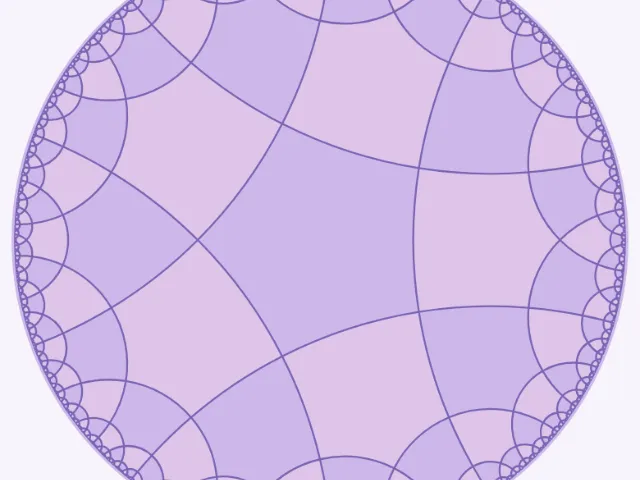
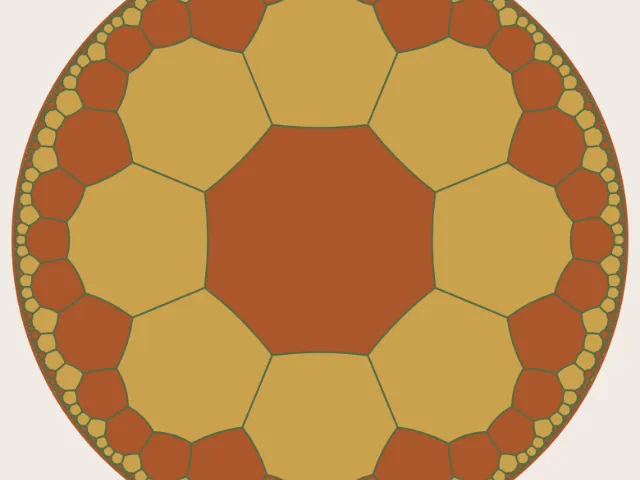
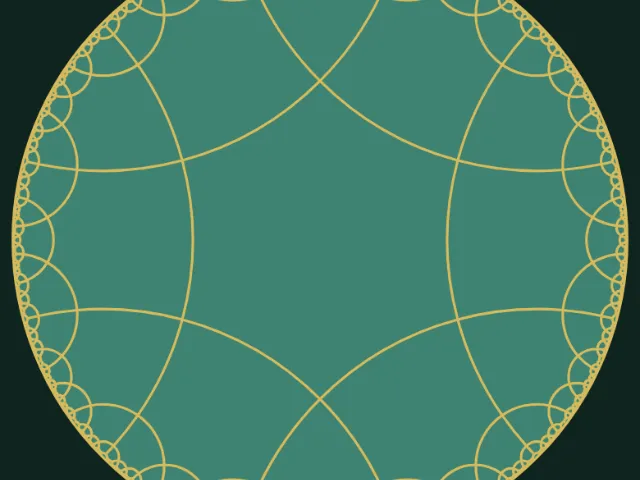
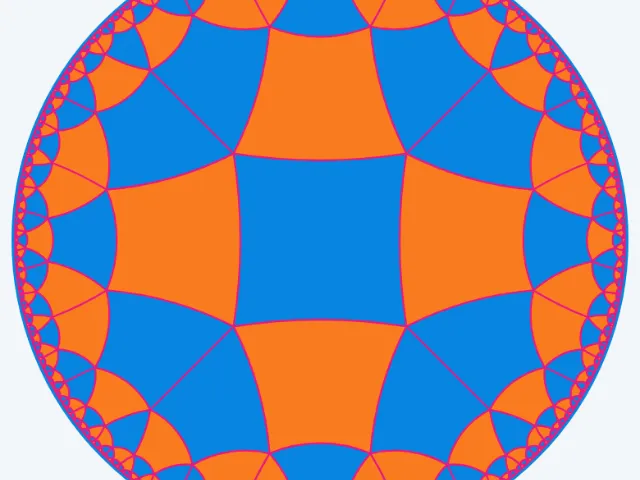
Tiles that shrink towards the edge of a circle and never run out. Choose a {p,q} tiling of the hyperbolic plane, shown in the Poincaré disk like Escher’s Circle Limit, colour it as a checkerboard or as lines, and export it as SVG or PNG.
Open in the generator How it works
What is a hyperbolic tiling?
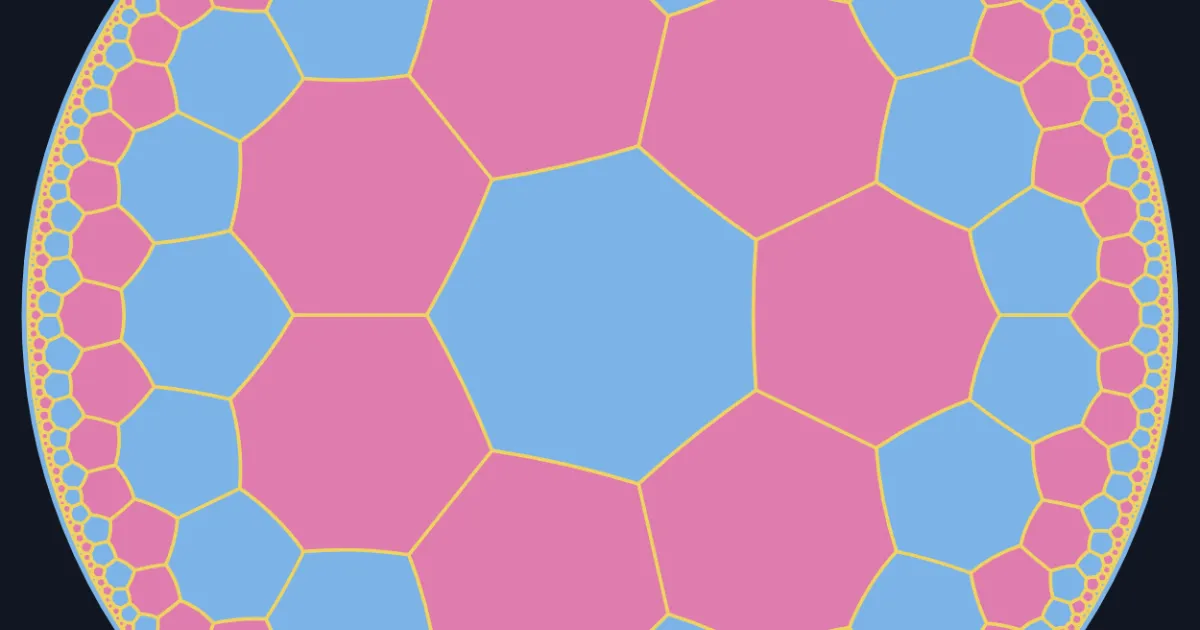
On a flat plane, regular polygons fit together in only three ways: triangles, squares or hexagons. On the hyperbolic plane, a curved surface where parallel lines drift apart, there are infinitely many regular tilings. In seven-sided polygons with three at every vertex, the angles are small enough that the tiling keeps growing outward without end.
To draw an infinite surface on a page, mathematicians use the Poincaré disk model: the whole hyperbolic plane is squeezed into a circle, and equal tiles look smaller and smaller towards the edge. Escher used this model in his Circle Limit woodcuts (1958–1960).
How the generator builds them
A tiling is named {p,q}: regular p-sided polygons, with q of them meeting at every vertex. It is hyperbolic when (p − 2)(q − 2) is greater than 4, so {7,3}, {5,4} and {4,5} all qualify, while {4,4} (a flat grid) does not. Ornamatic reflects the central polygon across its sides again and again and draws the result inside the disk.
A hyperbolic tiling cannot be repeated like wallpaper, so the result is a single poster, not a seamless tile. It exports as SVG or PNG.
What you can adjust
- Tiling — {7,3}, {8,3}, {4,5}, {5,4}, {6,4}, {4,6}, {5,5}, {3,7} or {3,8}.
- Kind — a checkerboard of two alternating colours, or only the lines between the tiles.
- Outline — the thickness of the edges.
- Colours — any palette.
Export and use
Download the poster as PNG or SVG. The patterns you create are free to use, personally or commercially.