Truchet tile pattern generator
Two simple tiles, placed at random, make endless winding paths. Choose Smith arcs, diagonals, triangles, arcs on hexagons or multi-scale Truchet, shuffle the layout, and export a seamless pattern as SVG, PNG or CSS.
Open in the generator How it works

What are Truchet tiles?
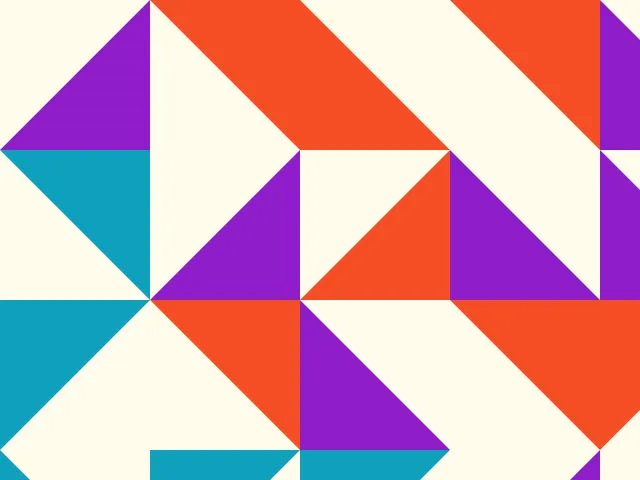
In 1704 the French priest Sébastien Truchet described square tiles divided along a diagonal into a light half and a dark half. Each tile can be turned in four ways, and when many are laid side by side the halves join into varied shapes.
The version that is most used today replaces the diagonal with two quarter-circle arcs, as introduced by Cyril Stanley Smith in 1987. Place the tile at a random turn in every cell, and the arcs join into continuous curving lines with no beginning or end.
How the generator builds them
The generator fills a grid with copies of one tile, turning each at random. The turns are fixed by a seed, so “Shuffle” gives a new arrangement, and the same link always gives the same pattern. Every tile joins its neighbours on all four sides, so the block of cells repeats seamlessly.
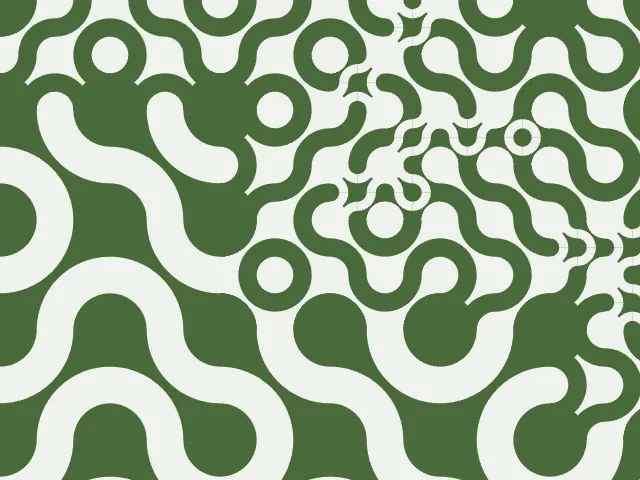
Multi-scale Truchet (described by Christopher Carlson in 2018) allows a cell to be split into four smaller cells, each with its own tile. Larger arcs then pass between clusters of small ones, and the pattern gains depth.
What you can adjust
- Tile type — arcs (Smith), diagonals, triangles, quarter circle, arcs on hexagons or multi-scale.
- Cells per period — how many cells fit in one tile.
- Line thickness — from hairlines to thick bands.
- Multi-scale — the number of levels, the chance that a cell splits, and the share of crosses and bridges among the arcs.
- Shuffle — a new random arrangement of the same tiles.
- Colours — any palette.
Export and use
Download the seamless tile as PNG or SVG, or copy a ready CSS background. The patterns you create are free to use, personally or commercially.