Ammann–Beenker tiling generator
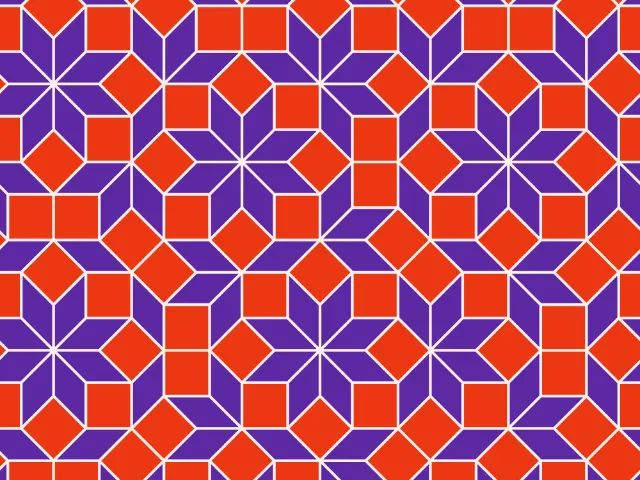
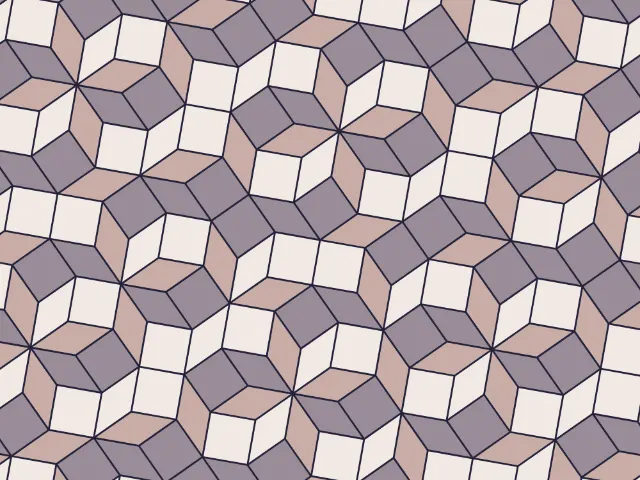
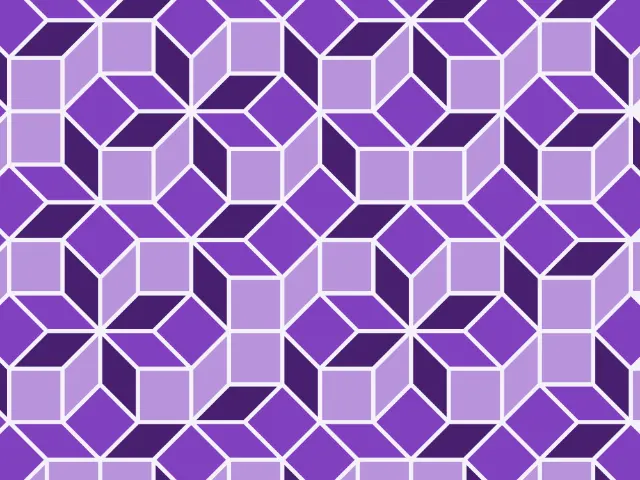
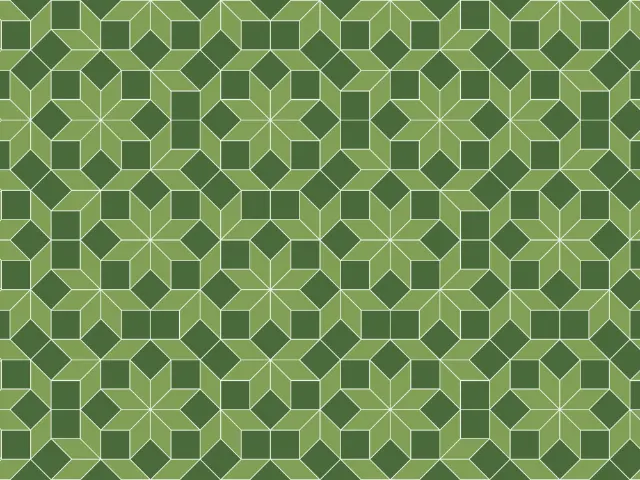
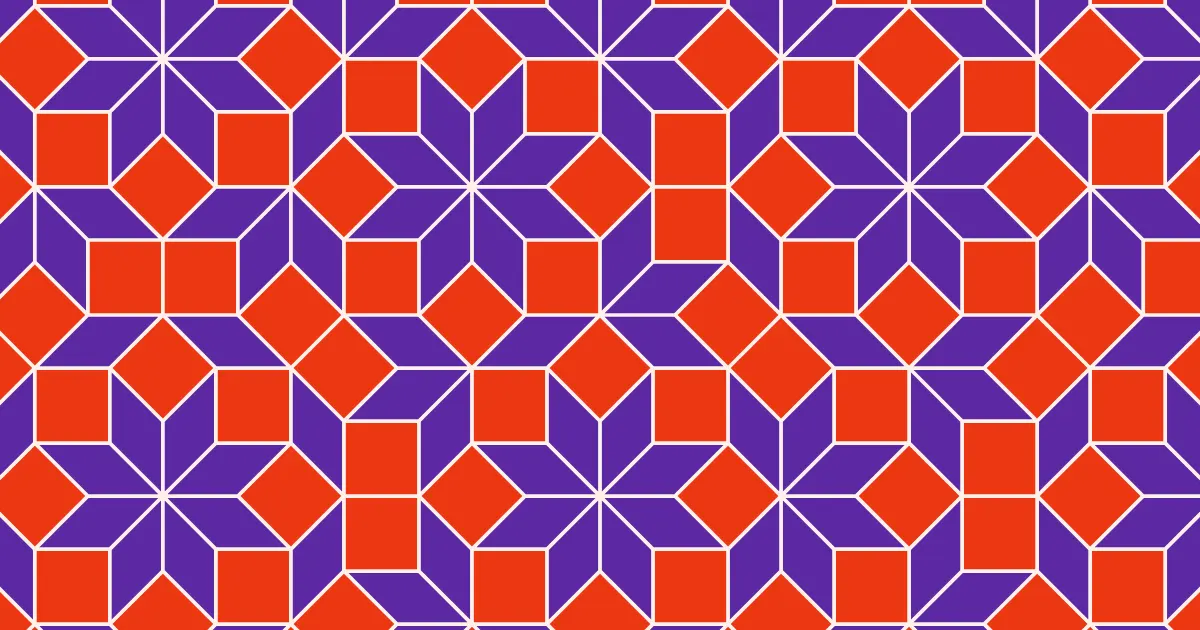
A tiling with eight-fold symmetry that never repeats. Squares and rhombi gather into eight-pointed stars, and no two neighborhoods in the picture are quite alike. Color the tiles by shape or by direction, choose the size of the poster, and export it as SVG or PNG.
Open in the generator How it works
Eight-fold order without repeating
Ordinary tilings repeat: shift the picture and it lands on itself. In the 1970s the amateur mathematician Robert Ammann found tilings that never repeat yet are full of order, and in 1982 F. P. M. Beenker described one of them in detail. It uses two shapes only: a square and a rhombus with a 45° angle. Locally the pattern has eight-fold symmetry, which an ordinary repeating tiling cannot have, and it is full of eight-pointed stars.
The number that governs it is the silver ratio, 1 + √2, much as the golden ratio governs the Penrose tilings. The rhombi are about √2 times as many as the squares. Materials whose atoms are arranged with such eight-fold order, called octagonal quasicrystals, have been observed in some alloys.
How the generator builds them
Ornamatic uses de Bruijn’s multigrid method. Four sets of parallel lines are drawn, at 0°, 45°, 90° and 135°, each set shifted by a random amount. Every point where two lines cross becomes one tile: a rhombus whose sides run in the directions of those two sets. Where the lines are perpendicular the tile is a square. The corners are computed exactly, so the tiles fit together without gaps or overlaps.
Because the tiling never repeats, it cannot be a seamless tile, so it is a poster, like the Penrose tilings. A different offset gives a different picture; they all look alike up close, and none repeats.
What you can adjust
- Poster radius — in tile edges; the larger, the smaller the tiles.
- Joint — the gap between tiles.
- Colors — by shape (squares and rhombi), by direction, or one color; any palette.
- Rotation — turn the whole tiling, in advanced mode.
- Other tiling — a new random offset of the grids.
Export and use
Download the picture as PNG or SVG. The patterns you create are free to use, personally or commercially.