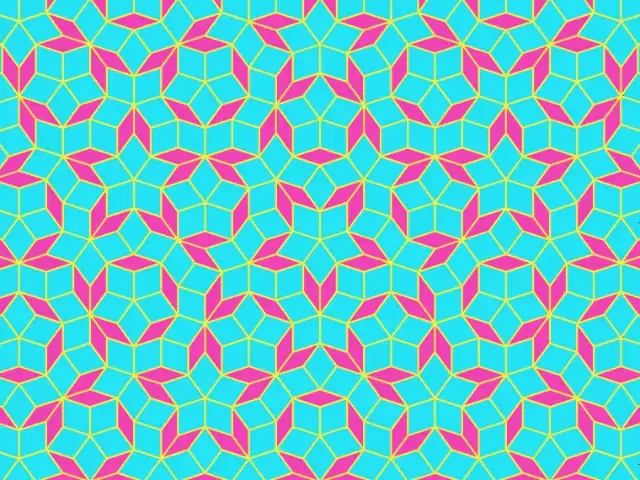
Wang tiles pattern generator
Square tiles whose edges carry colors, laid so that touching edges agree. Choose the number of colors, how many tiles make up the repeat and how strongly colors group into larger shapes, and export a seamless mosaic as SVG, PNG or CSS.
Open in the generator How it works

Tiles with colored edges
A Wang tile is a square with a color on each of its four edges. Tiles are placed side by side without turning them, and two tiles may touch only along edges of the same color. The mathematician Hao Wang introduced them in 1961 while studying questions of logic, and they turned out to link tilings to computation.
Wang first conjectured that any set of such tiles that can cover the plane can also do it with a repeating pattern. His student Robert Berger showed in the 1960s that this is false, by finding a set that tiles the plane only without repeating. Later work cut such sets down to a few dozen tiles and then to just a handful.
How the generator builds them
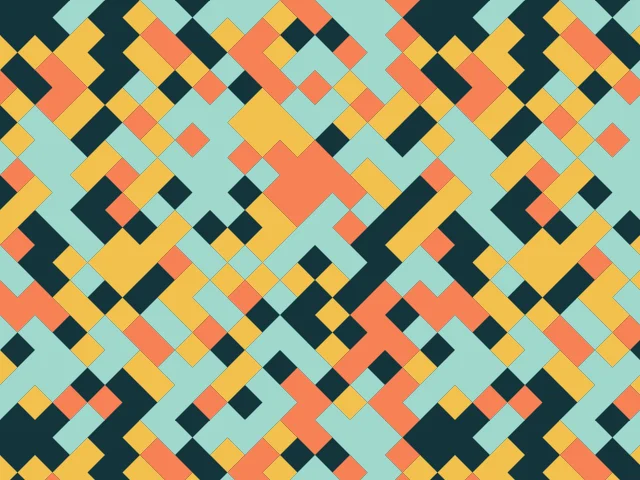
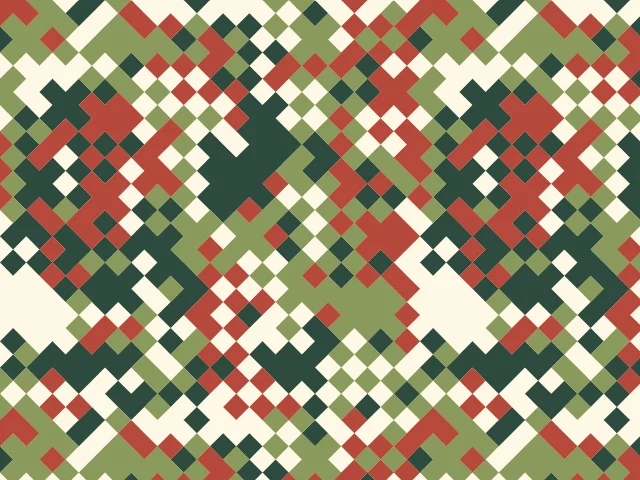
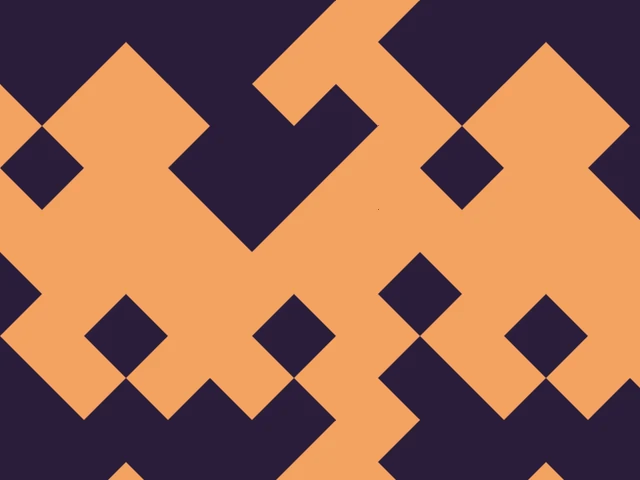
Ornamatic does not use an aperiodic set. It chooses the colors for the edges of a square grid that wraps around the tile, so that every tile automatically fits its neighbors and the pattern repeats exactly. Each tile is drawn as four triangles, one per edge, in the color of that edge, which turns the grid into a mosaic of diamonds and squares.
The first color is the ground. The clustering setting makes an edge likely to copy the color of its neighbor, which grows larger shapes of one color.
What you can adjust
- Edge colors — 2, 3 or 4, the first being the ground.
- Tiles across — from 3 to 16 tiles in the repeat; more tiles give a finer mosaic.
- Clustering — from a scatter of single triangles to large shapes.
- Other tiling — a new draw of the edge colors.
- Colors — a ground and up to three colors; any palette.
Export and use
Download the seamless tile as PNG or SVG, or copy a ready CSS background. The patterns you create are free to use, personally or commercially.